Autonomous Vehicle/Video Geometry
Homography
Naranjito
2025. 4. 4. 18:52
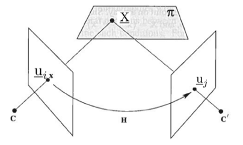

This figure explains the concept of Homography in computer vision — specifically, how to map one image to another when viewing the same plane in the world from two different viewpoints (i.e., two different camera positions).
- C and C′ are two camera centers.
- A 3D point X lies on a plane π.
- The point projects to image 1 as and to image 2 as uj.
- Because the point lies on the same plane, there's a homography H that maps one image point to the other.
- Homography H
\({u}_j=\mathbf{H}\mathbf{u}_i\)
\({u}_j, {u}_i\) : 2D points in two different images (image coordinates in homogeneous form).
H : 3×3 homography matrix that transforms point \({u}_i\) from image 1 into the corresponding point \({u}_j\) in image 2.
\({u}_j, {u}_i\) : 2D points in two different images (image coordinates in homogeneous form).
H : 3×3 homography matrix that transforms point \({u}_i\) from image 1 into the corresponding point \({u}_j\) in image 2.
| Term | Meaning |
| Planar structure | Homography is valid only when the scene is planar (e.g., a flat surface like a wall or checkerboard). |
| 8 DoF | The matrix H has 9 values but is up to a scale, so it has 8 degrees of freedom. |
| Plane-induced H | The homography arises from a plane π in 3D space viewed by two cameras. |