Naranjito
2025. 4. 3. 19:19
- Traditional methods like SIFT/SURF use Gaussian blurring (a linear scale space), which blurs both boundaries and noise equally. This weakens edges. KAZE uses a nonlinear diffusion filter to:
- Preserve edges (boundaries)
- Suppress noise
This leads to better keypoint localization, especially around object edges.

KAZE constructs a nonlinear scale space using the following equation:
\begin{equation}\frac{\partial L}{\partial t}=\mathrm{div}(c(x,y,t)\cdot\nabla L)\end{equation}
- L: Image at time t
- ∇L: Gradient (edge direction)
- c(x,y,t): Conductivity function – controls the diffusion speed
- High ∣∇L∣ (strong edge): small → less blurring
- Low ∣∇L∣ (flat region): large c → more blurring
This way, KAZE blurs noise but preserves edges.
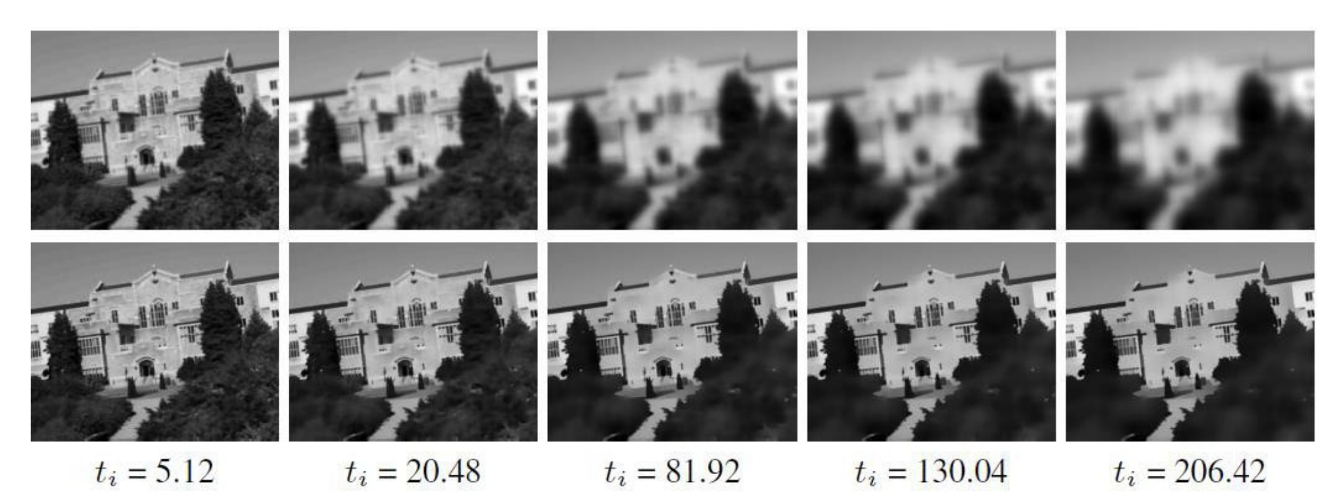
Instead of Gaussian pyramids (like in SIFT), KAZE builds scale space with increasing diffusion time  . The figure shows blurred images at increasing time steps .
| Feature | SIFT (Scale-Invariant Feature Transform) | SURF (Speeded Up Robust Features) | KAZE (Nonlinear Scale Space) |
| Scale Space | Gaussian pyramid (linear scale space) | Gaussian pyramid (linear scale space) | Nonlinear diffusion (preserves edges and boundaries) |
| Detector | Difference of Gaussian (DoG) | Hessian matrix (approximated by box filters) | Determinant of Hessian matrix in nonlinear space |
| Descriptor | Gradient orientation histograms | Haar wavelet responses | First-order image derivatives |
| Rotation Invariance | Yes | Yes | Yes |
| Illumination Invariance | Normalized gradient magnitude | Normalized Haar responses | Normalized first-order derivatives |
| Computation Speed | Slower | Faster than SIFT | Slower (due to nonlinear PDE solving) |
| Robustness | Good for scale and rotation | Good, faster alternative to SIFT | Better at preserving edge structures and boundaries |
| Descriptor Dimension | 128 | 64 | 64 |
| Key Innovation | Scale-space extrema + gradient histograms | Integral image + box filters for speed | Nonlinear scale space via anisotropic diffusion |