Deep Learning/PyTorch
Pytorch-contiguous
Naranjito
2022. 12. 5. 16:02
- contiguous
Returns a contiguous in memory tensor containing the same data as self tensor. If self tensor is already in the specified memory format, this function returns the self tensor.
Let's just define two tensors that shape are same.
a = torch.randn(3, 4)
a.transpose_(0, 1)
b = torch.randn(4, 3)

# both tensor shape is (4, 3)

print(a)
>>>
tensor([[-0.7290,  0.7509,  1.1666],
        [-0.9321, -0.4360, -0.2715],
        [ 0.1232, -0.6812, -0.0358],
        [ 1.1923, -0.8931, -0.1995]])'''

print(b)
>>>
tensor([[-0.1630,  0.1704,  1.8583],
        [-0.1231, -1.5241,  0.2243],
        [-1.3705,  1.2717, -0.6051],
        [ 0.0412,  1.3312, -1.2066]])'''
Now, let's call it-Memory address of each tensors a,b-in the order of right direction.
#tensor a
for i in range(4):
    for j in range(3):
        print(a[i][j].data_ptr())
>>>
94418119497152
94418119497168
94418119497184
94418119497156
...


#tensor b
for i in range(4):
    for j in range(3):
        print(b[i][j].data_ptr())
>>>
94418119613696
94418119613700
94418119613704
94418119613708
...
b is increasing by 4 per line but a is not.
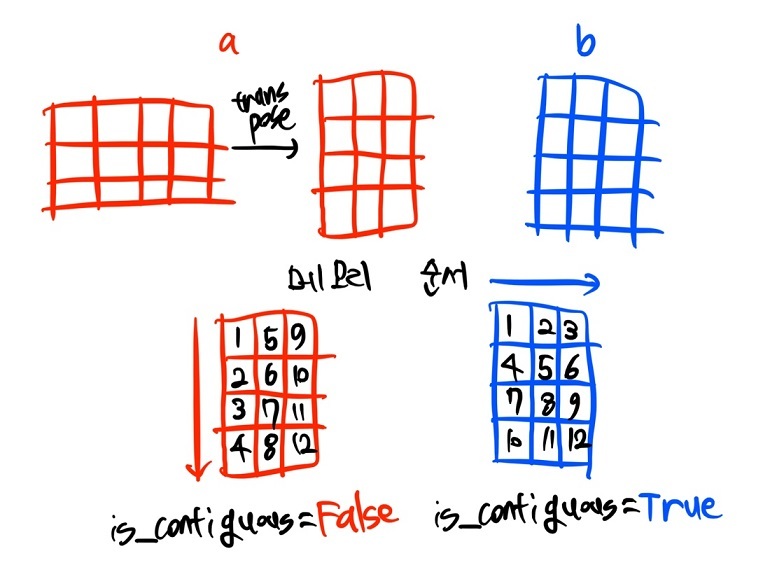
In other words, b is axis=0, memory is stored by right direction,
however a is axis=1, it is stored by going down direction.
a is contiguous=True
b is contiguous=False
We can apply contiguous=True condition.
a.is_contiguous() # False

# change contiguous condition to True
a = a.contiguous()

a.is_contiguous() # True