- A filtering technique that uses a Gaussian function to create a smoothing effect on an image. The blur reduces image noise and reduces detail by averaging pixel values with their neighbors.
- it suppresses high frequency noise, keeps larger scale structure, makes gradients reflect real boundaries.
- When we apply Gaussian Blur, we create a kernel (a small matrix). The kernel is then convolved with the image, which means each pixel’s new value becomes a weighted average of itself and its neighboring pixels, with weights determined by the Gaussian function.
- When we apply Gaussian Blur, the pixel intensities get averaged with surrounding pixels, with closer pixels having more influence than farther ones.
For example, if we have a sharp edge in an image:
Before Gaussian Blur:
10 10 10 | 200 200 200
10 10 10 | 200 200 200
10 10 10 | 200 200 200
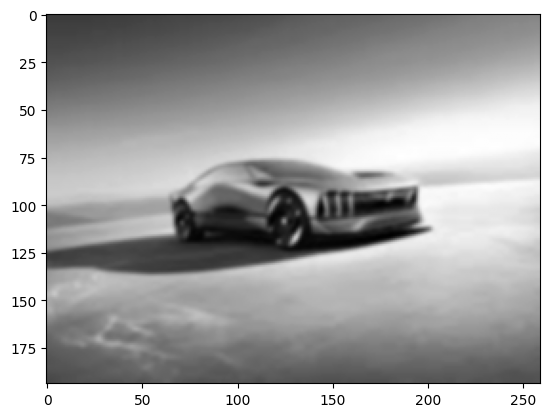
After Gaussian Blur:
10 20 50 | 150 190 200
10 20 50 | 150 190 200
10 20 50 | 150 190 200

The sharp edge becomes a gradual transition. Pixels near the edge get averaged, creating a smoother gradient.
'Deep Learning > Object Detection' 카테고리의 다른 글
| Thresholding, Contours, Morphology, Erosion, Dilation (0) | 2026.03.03 |
|---|---|
| Image Intensity, Canny, Sobel (0) | 2024.05.28 |
| Object Detection, mAP(The Mean Average Precision) (0) | 2024.02.16 |
| YOLO(You Only Look Once) (0) | 2024.02.12 |
| (prerequisite-YOLO) One Stage Object Detection (0) | 2024.02.11 |