
- The robot in the image is sending out a green dashed line toward a cylindrical object, representing a measurement (probably range + bearing).
- This is typical of range-bearing sensing, where you get both:
- Distance (range) to the object
- Direction (bearing) of the object
- However, uncertainty in these sensors makes localization of objects ambiguous.
- Banana Shape Problem
- A common nonlinear uncertainty distribution in range-bearing sensing.
- When you only measure distance and angle to an object from one position, your uncertainty in object location is not symmetric — it forms a curved, banana-like shape in 2D.
For example,
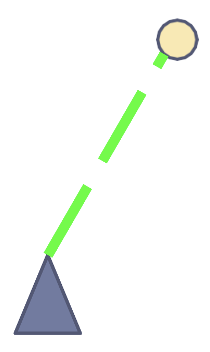
- An object is sensed 20 cm away at a 60° angle.
- But the sensors are imperfect:
Range error: ±1 cm
Bearing error: ±10°
- These errors create uncertainty in the actual object location.
- The triangle and green dashed line show the robot and the direction of measurement, while the shaded area suggests the range of possible actual positions.
- To model uncertainty, generate 1,000 samples (particles) assuming:
Range r ∈ [19, 21] cm
Angle a ∈ [50°, 70°]
- This produces a spread of points in 2D space that represent where the object might be.
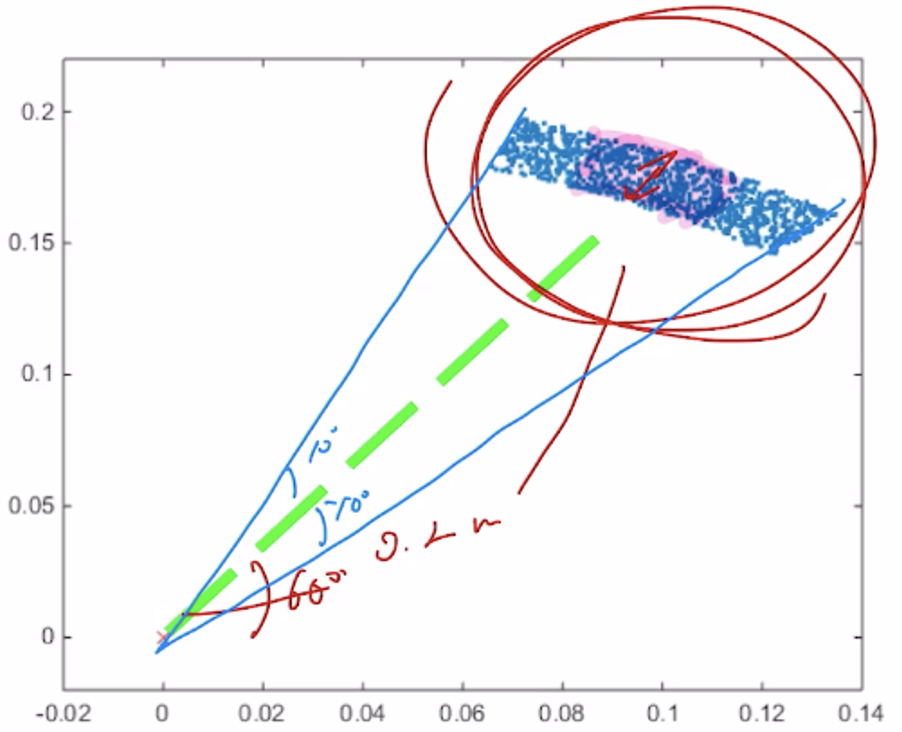
- The generated particles form a cloud in a banana-like shape.
- One of them is the actual object, but we don’t know which.
- This motivates using a particle filter — a probabilistic approach that updates the belief of where the object is based on measurements.
- The banana-shaped distribution is not symmetric.
- It is not Gaussian, but a particle cloud.
- A first-order approximation may be fitted to this, but it’s not perfect.
- The transformation from range and bearing to Cartesian is nonlinear.
- We must linearize to apply linear estimation methods.
- Linearization of Nonlinear Equation
- This lets us represent the uncertainty locally using a matrix A (Jacobian) even though the original transformation is nonlinear.

- At this point, compute the Jacobian matrix A to approximate the local uncertainty.
'Autonomous Vehicle > Video Geometry' 카테고리의 다른 글
| Pangolin, Pangolin installation error (0) | 2026.01.19 |
|---|---|
| [Uncertainty] Odometry (0) | 2025.11.27 |
| [Uncertainty] Gaussian VS Samples (0) | 2025.11.27 |
| Root Shifting (0) | 2025.11.25 |
| 6-DOF (Degrees of Freedom) (0) | 2025.11.25 |