- Softmax Regression(Multi-class Classification)
Multi-Class Classification to choose one from three or more options.
- Softmax function
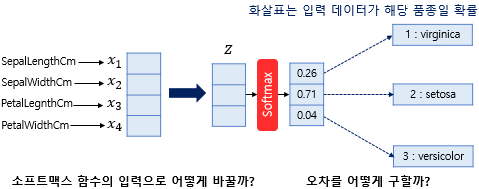
It applies this idea to the multi-class classification problem, where the sum of the probabilities is 1, not like a binary classification(2021.03.16 - [Machine Learning] - Linear Regression, Simple Linear Regression, Multiple Linear Regression, MSE, Cost function, Loss function, Objective function, Optimizer, Gradient Descent).
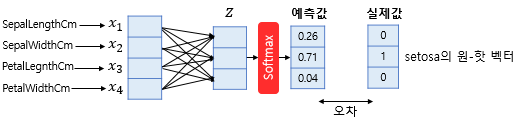
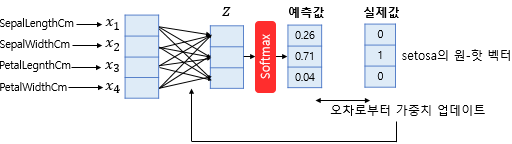
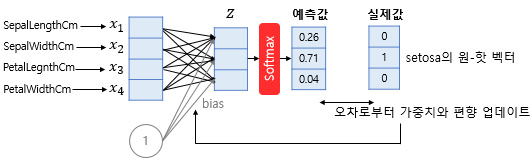
Let the sum of all probabilities be 1 and change it to probability.

Then,
\( \operatorname{softmax}(\mathbf{z}) = \left[ \frac{e^{z_1}}{\sum_{j=1}^{3} e^{z_j}}, \frac{e^{z_2}}{\sum_{j=1}^{3} e^{z_j}}, \frac{e^{z_3}}{\sum_{j=1}^{3} e^{z_j}} \right] = [p_1, p_2, p_3] = \hat{\mathbf{y}} \quad \text{(예측값)} \)
⬇︎

⬇︎

⬇︎
⬇︎
⬇︎
⬇︎
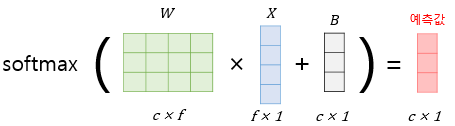
Example 1.
 |
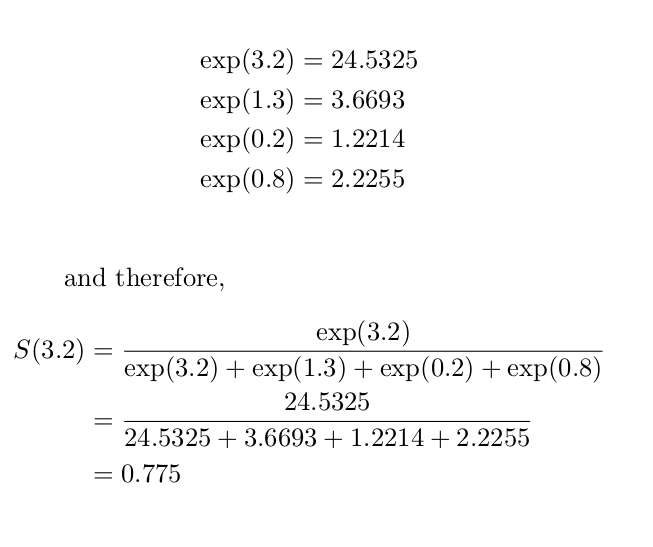 |
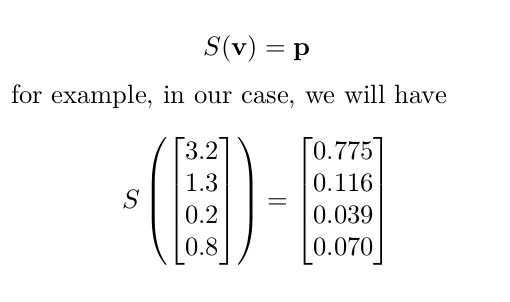 |
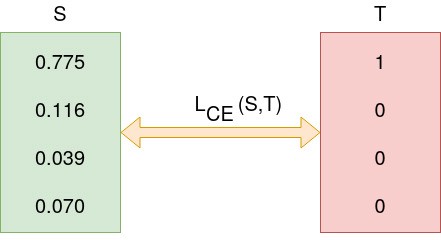 |
Example 2.
Choose one of the three.
| SepalLengthCm() | SepalWidthCm() | PetalLengthCm() | PetalWidthCm() | Species(y) |
| 5.1 | 3.5 | 1.4 | 0.2 | setosa |
| 4.9 | 3.0 | 1.4 | 0.2 | setosa |
| 5.8 | 2.6 | 4.0 | 1.2 | versicolor |
| 6.7 | 3.0 | 5.2 | 2.3 | virginica |
| 5.6 | 2.8 | 4.9 | 2.0 | virginica |
Then,
\( \hat{Y} = \operatorname{softmax}(XW + B) \)
can be
\( \begin{pmatrix} y_{11} & y_{12} & y_{13} \\ y_{21} & y_{22} & y_{23} \\ y_{31} & y_{32} & y_{33} \\ y_{41} & y_{42} & y_{43} \\ y_{51} & y_{52} & y_{53} \end{pmatrix} = \operatorname{softmax} \Bigg( \begin{pmatrix} x_{11} & x_{12} & x_{13} & x_{14} \\ x_{21} & x_{22} & x_{23} & x_{24} \\ x_{31} & x_{32} & x_{33} & x_{34} \\ x_{41} & x_{42} & x_{43} & x_{44} \\ x_{51} & x_{52} & x_{53} & x_{54} \end{pmatrix} \begin{pmatrix} w_{11} & w_{12} & w_{13} \\ w_{21} & w_{22} & w_{23} \\ w_{31} & w_{32} & w_{33} \\ w_{41} & w_{42} & w_{43} \end{pmatrix} + \begin{pmatrix} b_1 & b_2 & b_3 \\ b_1 & b_2 & b_3 \\ b_1 & b_2 & b_3 \\ b_1 & b_2 & b_3 \\ b_1 & b_2 & b_3 \end{pmatrix} \Bigg) \)
- Softmax Cost function(Cross Entropy)
Softmax regression uses a cross entropy function as a cost function.
| Cost function | ||
| Linear Regression | MSE(Mean Squared Error) | 2021.03.16 - [Machine Learning] - Linear Regression, Simple Linear Regression, Multiple Linear Regression, MSE, Cost function, Loss function, Objective function, Optimizer, Gradient Descent |
| Logistic Regression | H(x) = sigmoid(Wx + b) | 2021.03.17 - [Machine Learning] - Logistic Regression, Sigmoid function |
| Softmax Regression(Multi-class Classification) | Softmax Cost function(Cross Entropy) | 2021.03.31 - [Machine Learning] - Entropy, Cross-Entropy |
import torch.nn.functional as F

z=torch.rand(3,5, requires_grad=True)
hypothesis=F.softmax(z, dim=1)
tensor z with shape (3, 5):
dim = 0 (across rows/column-wise):
- Softmax is applied down each column
- Each of the 5 columns will sum to 1
- You're normalizing the 3 values within each column
z = [[a, b, c, d, e],
     [f, g, h, i, j],
     [k, l, m, n, o]]

# Column 0: softmax([a,f,k]) → sums to 1
# Column 1: softmax([b,g,l]) → sums to 1
# ... and so on
dim = 1 (across columns/row-wise):
- Softmax is applied across each row
- Each of the 3 rows will sum to 1
- You're normalizing the 5 values within each row
- dim=1 is typical for classification where each row is a sample and columns are class scores
z = [[a, b, c, d, e],    # Row 0: softmax([a,b,c,d,e]) → sums to 1
     [f, g, h, i, j],    # Row 1: softmax([f,g,h,i,j]) → sums to 1
     [k, l, m, n, o]]    # Row 2: softmax([k,l,m,n,o]) → sums to 1
towardsdatascience.com/softmax-activation-function-how-it-actually-works-d292d335bd78
'Machine Learning' 카테고리의 다른 글
| Entropy, Cross-Entropy (0) | 2021.03.31 |
|---|---|
| Support Vector Machine, Margin, Kernel, Regularization, Gamma (0) | 2021.03.30 |
| Logistic Regression, Sigmoid function (0) | 2021.03.17 |
| Scalar vs Vector vs Matrix vs Tensor (0) | 2021.03.17 |
| Linear Regression, Simple Linear Regression, Multiple Linear Regression, MSE, Cost function, Loss function, Objective function, Optimizer, Gradient Descent (0) | 2021.03.16 |