- In linear algebra, an eigenvector vector is a (nonzero) vector that has its direction unchanged (or reversed) by a given linear transformation. More precisely, An eigenvector v of a linear transformation A is scaled by a constant factor λ when the linear transformation is applied to it:
Av=λv

v: eigenvector (special direction)
λ: eigenvalue (how much it scales)
The corresponding eigenvalue, characteristic value, or characteristic root is the multiplying factor λ (possibly a negative or complex number).

Here, A is a n * n matrix, vector v is called an eigenvector that is satisfied Av=λv and shouldn't be a zero, and λ is called an eigenvalue.
v: eigenvector (special direction)
λ: eigenvalue (how much it scales)Let’s find the eigenvectors/eigenvalues.
- x-axis direction \( v_1 = \begin{bmatrix} 1 \\ 0 \end{bmatrix} \), then Apply A : \( A v_1 = \begin{bmatrix} 2 & 0 \\ 0 & 1 \end{bmatrix} \begin{bmatrix} 1 \\ 0 \end{bmatrix} = \begin{bmatrix} 2 \\ 0 \end{bmatrix} = 2 \begin{bmatrix} 1 \\ 0 \end{bmatrix} \), herefore eigenvalue λ1=2.
- at the same time, y-axis direction \( v_2 = \begin{bmatrix} 0 \\ 1 \end{bmatrix} \), then Apply A :\( A v_2 = \begin{bmatrix} 2 & 0 \\ 0 & 1 \end{bmatrix} \begin{bmatrix} 0 \\ 1 \end{bmatrix} = \begin{bmatrix} 0 \\ 1 \end{bmatrix} = 1 \begin{bmatrix} 0 \\ 1 \end{bmatrix} \), therefore eigenvalue λ2=1.

The example here, based on the Mona Lisa, provides a simple illustration. Each point on the painting can be represented as a vector pointing from the center of the painting to that point. The linear transformation in this example is called a shear mapping. Points in the top half are moved to the right, and points in the bottom half are moved to the left, proportional to how far they are from the horizontal axis that goes through the middle of the painting. The vectors pointing to each point in the original image are therefore tilted right or left, and made longer or shorter by the transformation. Points along the horizontal axis do not move at all when this transformation is applied. Therefore, any vector that points directly to the right or left with no vertical component is an eigenvector of this transformation, because the mapping does not change its direction. Moreover, these eigenvectors all have an eigenvalue equal to one, because the mapping does not change their length either.
    • ∣λ∣>1: stretch
    • 0<∣λ∣<1: shrink
    • negative λ: flip direction too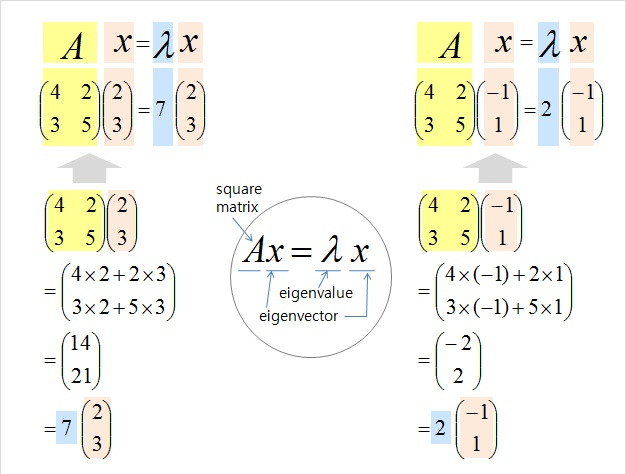
'Math' 카테고리의 다른 글
| Null Space (0) | 2024.11.19 |
|---|---|
| Square Matrix (0) | 2024.11.19 |
| Quaternion (0) | 2024.09.29 |
| Tensor product(Outer product) VS Dot Product(Inner product) (0) | 2024.09.26 |
| Matrix Multiplication (0) | 2024.09.26 |